Showing posts with label cranberries. Show all posts

Thursday, May 03, 2018

Nutritional composition of cranberries

Nutritionally, cranberries have long been recognized as rich sources of ascorbic acid, vitamin A, thiamine, riboflavin, niacin, dietary fiber, and the essential minerals such as calcium, magnesium, manganese, phosphorus and potassium.

Cranberries also contain a unique blend of organic acids. Citric and malic acids predominate, followed by quinone (approx. 1.0%) and benzoic acid (approx. 0.01%), typical for a large variety of fruits.

Raw cranberries are fairly low in calories (46 kcal per 100 g) and carbohydrate (11%). Monosaccharides comprise from 2.2% to 6.0% of the small cranberry and from 3.4 to 7.1 of the large cranberry and are dominated by glucose and fructose, with glucose amounting to 58.9 – 65.9%.

The small cranberry usually contains only 0.01% - 0.5% sucrose, whereas the large cranberry accumulates significantly larger amounts (3.9-5.3%) of sucrose.

Cranberries contain ascorbic acid. The small cranberries accumulate and average of between 15.3% an 30% ascorbic acid. They are a good source of fiber and bioflavonoids, and a fair source of potassium. A serving of fresh cranberries is a good source of antioxidant polyphenols; and contains 1 mg of sodium.
Nutritional composition of cranberries

Friday, February 02, 2018

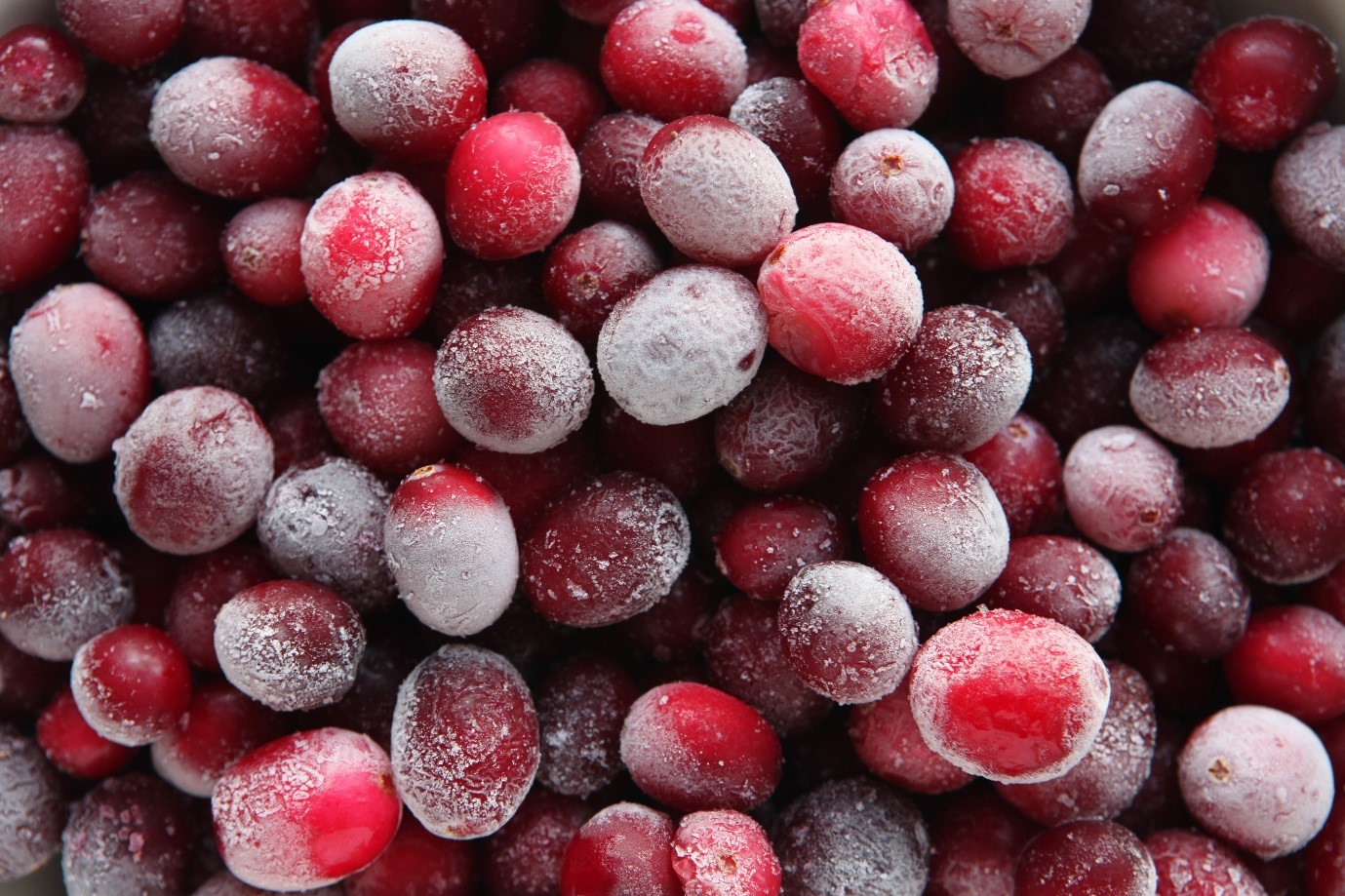
Frozen cranberries

Cranberries are among the simplest fruits to judge and keep. A bright red berry is a fresh berry, packed with flavor.

If frozen, cranberries will keep for several years. To freeze them there is also a specific procedure: first spread the fresh cranberries on a cookie set sheet and place the sheet in the freezer. After a couple of hours, the frozen berries will be ready to be transferred into a freezer beg and stored safely.

In factory large quantities of cranberries are frozen for later processing into sauces, jelly and juice. Frozen cranberries is also good for baked goods, cooked sauce and compotes and smoothies and shakes. Frozen cranberries maintain good quality and have a relatively long shelf-life.
Frozen cranberries

Friday, October 27, 2017

Processing of cranberry jelly and cranberry sauce

About 80% of the cranberry crop is processed. Some of the processed berries are made directly into cranberry juice drinks and traditional types of cranberries sauces.

In manufacturing cranberries jelly, the clear juice from the boiled fruit that has been passed through a pulper, is nixed with sugar, about 0.35% of dispersed pectin is added and no water used.

The mixture is heated briefly to bring the soluble solid content to 65% and citric solution is added to regulate the pH 3.0 to 3.2.
Cranberry sauce production starts with frozen fruit. After the frozen fruit is dumped into warm water for defrosting the slurry passes through scavenger and rock trap prior dewatering and cooking.

For whole cranberry sauce carefully hand-sorted berries are added to the puree after the first cooking. No additional pectin is needed to set the jellied sauce because the berries have an abundance of natural pectin.

Both cranberry sauce and cranberry jelly are preserved by heat processing. If the products are heated to about 190 F (87.8 C) prior to filling into containers further heating is not necessary to attain commercial after sealing the containers.

If packed at lower temperatures, the containers should be sealed and heated in a water bath or with spray of water at 185 – 200 F (85-93.3 C) prior to cooling.
Processing of cranberry jelly and cranberry sauce

Thursday, May 19, 2016

Cranberries and antioxidants

Antioxidants are compounds that prevent cell damage by countering free reactions in the body.

Cranberries are among some of the finest fruits that are most investigated by scientist for their antioxidative behavior. Since the seventeenth century, cranberries have been used for an assortment of medicinal purposes: stomach ailments, liver problems and blood disorders.

Anthocyanins indeed are key antioxidants in cranberries but in some cases flavonoids and proanthocyanidins (PACs) are stronger antioxidants than anthocyanins and ascorbic acid contributes very little to antioxidants content and activity.

Antioxidants found in cranberries are of special importance and contribute greatly to the wellbeing of the body. PACs inhibit the fimbrial adhesion of bacteria, including Escherichia coli, to the urinary tract epithelium. Of the bacterial cannot adhere, they will be washed away with the flow of urine.

Cranberries are phytochemical phenoms that provide five times the antioxidant content of broccoli due to their high concentration of anthocyanidins. These antioxidants have been shown to inhibit the development of atherosclerosis, cancer and other degenerative disease.

Tannins found in cranberries may also stop ulcers by lowering the ability of Helicobacter pylori to settle in the stomach.
Cranberries and antioxidants

Friday, July 12, 2013

History of cranberries in North America

The cranberry is an important ingredient in American history. It is known that American Indians used cranberries to make poultices for wounds. Especially when it was combined with cornmeal, cranberry was used to counteract blood poisoning. In addition, they enjoyed cooked cranberries that were sweetened with maple syrup or honey.

The colonists named the berries ‘crane berries; because their pink blooms resembled the heads of cranes. 

By the beginning of the 18th century the colonists were exporting cranberries to England.

The revolutionary War Veteran Henry Hall planted the first commercial cranberry beds in Massachusetts on Cape Cod in 1816. Hall noticed that a wealth of large berries were produced when the tides and wind swept some sand into his bog.

Bogs became the ideal medium for cranberry growth. By 1820 he was shipping his cranberries to Boston and New York City.

It did not take long for cranberry cultivation to spread across the United States especially in the states of Wisconsin, Massachusetts, New Jersey, Oregon and Washington.

Cranberries were first introduced to Holland when an American ship carrying barrels of cranberries was shipwrecked on the Dutch cost. The barrels were washed ashore, some berries took root and cranberries have been cultivated there from then on.

In the 1920s canned cranberry sauce was introduced and in the 1940s cranberry juice became commercially available.

Cranberry has been used to prevent and treat urinary tract infections since the 19th century.
History of cranberries in North America

The Most Popular Posts