Showing posts with label berry. Show all posts

Monday, November 12, 2018

Domestication of raspberry in history

The history of raspberry consumption and domestication goes back to ancient times. The European raspberry is a native of Europe from Greece and Italy, north into Scandinavia and far eastward into Asia.

It was name for Mount Ida, in Asia Minor and was possibly more or less cultivated in southern Europe in ancient times. Fruits were gathered from the wild by the people of Troy in the foothills of Mount Ida around the time of Christ. Records of domestication were found in 4th century writings of Palladius, a Roman agriculturist and seeds have been discovered at Roman forts in Britain.

It is believed that Roman soldiers spread the cultivation of this plant throughout Europe. Raspberry gradually grew in popularity over the centuries, and by the 1500s, R. idaeus was cultivated all over Europe.

King Edward I is recognized as the first person to call for the cultivation of berries. By the 17th century, British gardens were rich with berries and berry bushes. In 1829, 23 raspberry cultivars were liste0 in the “History of English Gardening”.

It was early brought to America by colonists from Europe and prior to the middle of the nineteenth century was the only raspberry commonly cultivated in USA.
Domestication of raspberry in history

Tuesday, December 27, 2016

Vitamin C content in camu-camu

The exotic camu-camu is grown in the nutrient-rich rain forests soil of Peru and other hot and damp tropical climates. The plant bears cherry-sized berries that are highly acidic, very tart, and are often sweetened to please human palette.

In the north-east region of Peru, people sometimes eat the fairly acidic camu-camu fruits fresh, but traditionally they have used them to make refreshments and liquors.

Camu-camu fruits have a higher vitamin C content, which is of particular use in treating a wide range of ailments, and they also possess important metabolites for nutrition and health. Vitamin C helps with immunity, tissue repair and healing as well as with cancer and cataract prevention.

In case anybody injured or have had a surgery , taking large quantities of vitamin C can help speed up the healing process.

The camu-camu berry is one of the world’s most potent sources of vitamin C – packing more than 60 times the amount preserving than the almighty orange.

Oranges often have around 1,000 ppm of vitamin C, while the camu-camu berry can have concentration as high as 50,000 ppm or about 2 grams of vitamin C per 100 grams of fruit.
Vitamin C content in camu-camu

Sunday, May 08, 2016

Serendipity berry

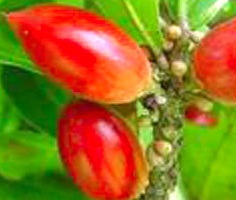
Another berry found in West and Central Africa is the fruit of Dioscoreophyllum cumminsii, a light red berry which grows in grape-like clusters.

Known as the ‘serendipity berry’ it is an herbaceous grown for its sweet berries, which are used as natural non-carbohydrate sweetener substitute. It grows in the rainforest during the rainy season from approximately July to October.

The fruits are red 1.3 long, in a grape-like cluster 50-100 in cluster, outer skin tough, pulp semi-solid, white, mucilaginous. While the berry is too sweet to have found use among the natives, parts of the plant are eaten. The sweetening principle is a polypeptide, soluble in water, but very large labile at high temperature.

The non-sucrose compound responsible for the sweet taste is classified as monellin, a sweet polypeptide. The sweetness of monellin is approximately 2500 times sweeter than sucrose in a weight basis.

Fruit fairly heavily from August through November, They are picked by hand and used as needed. Fruits are remarkably stable, and may be kept for several weeks at room temperature. Tubers dig in the dry season and sued as a vegetable.
Serendipity berry

The Most Popular Posts